Writing chemistry by hand: structures, reactions and equations
How to draw skeletal formulas, write balanced reaction equations and lay out a chemistry page so it is clear, with examples written by hand.
4 min read
Chemistry has its own visual language. A good chemistry page is not just text with a few formulas mixed in: structures, arrows, charges and conditions all have conventions, and following them makes your notes faster to write and much easier to read later. This guide covers the conventions that matter most in school and early university chemistry.
Skeletal formulas: draw less, show more
In a skeletal formula (also called a line-angle or bond-line formula), carbon atoms are not written. Every corner and every line end is a carbon atom, and each carbon is assumed to carry enough hydrogen atoms to make four bonds. Only other atoms, like oxygen, nitrogen or chlorine, are written as letters, together with hydrogen atoms attached to them (OH, NH₂).
That saves a lot of writing. Ethanol, CH₃CH₂OH, becomes a short zigzag with "OH" at the end. A six-carbon ring is just a hexagon.
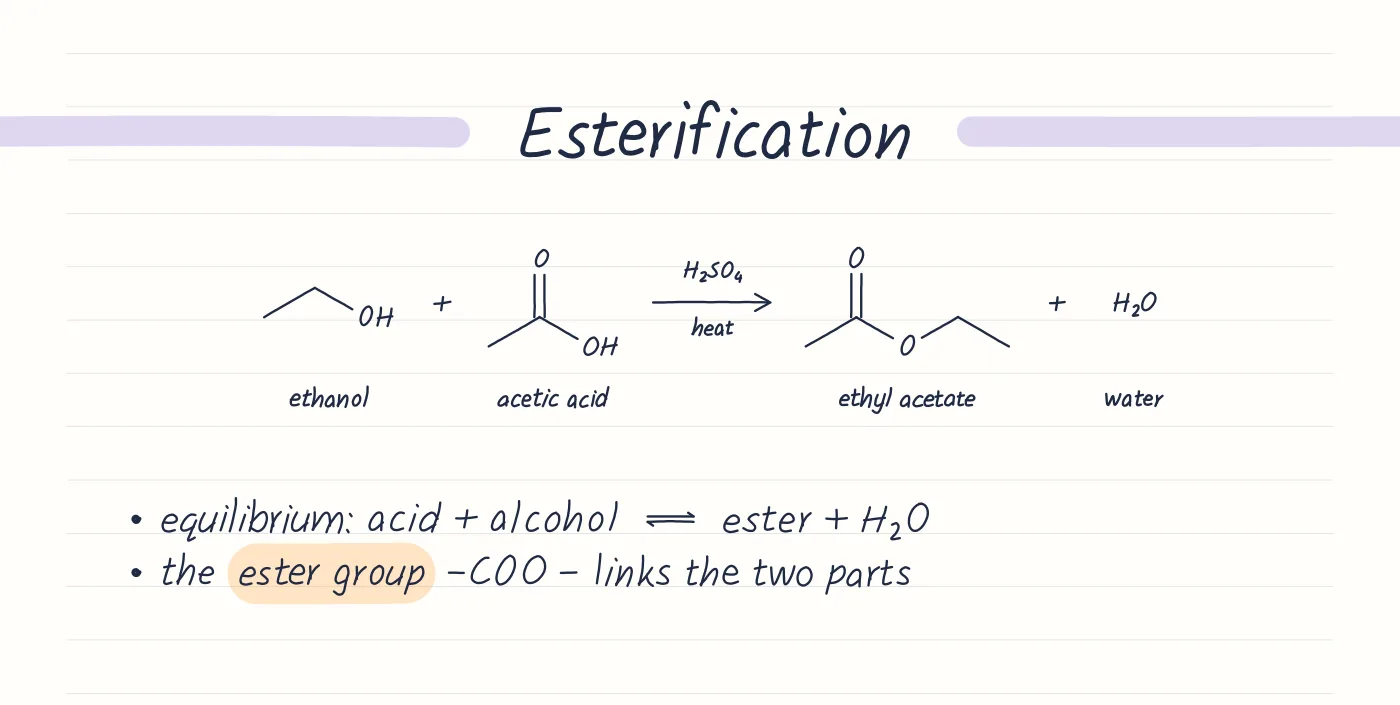
Some rules that keep skeletal formulas readable:
- Draw chains as zigzags, with angles of about 120 degrees, not as straight lines.
- Double bonds are two parallel lines; triple bonds three.
- Write heteroatoms clearly: O, N, S, Cl as letters, with their hydrogens (OH, not just O).
- Aromatic rings can be drawn with alternating double bonds or with a circle inside the hexagon. Pick one style and keep it.
- Wedges and dashes show 3D: a filled wedge points towards you, a dashed wedge away from you.
Structures worth practising
A few structures come up again and again. Being able to draw them quickly from memory saves time in exams and makes reaction mechanisms easier to follow.
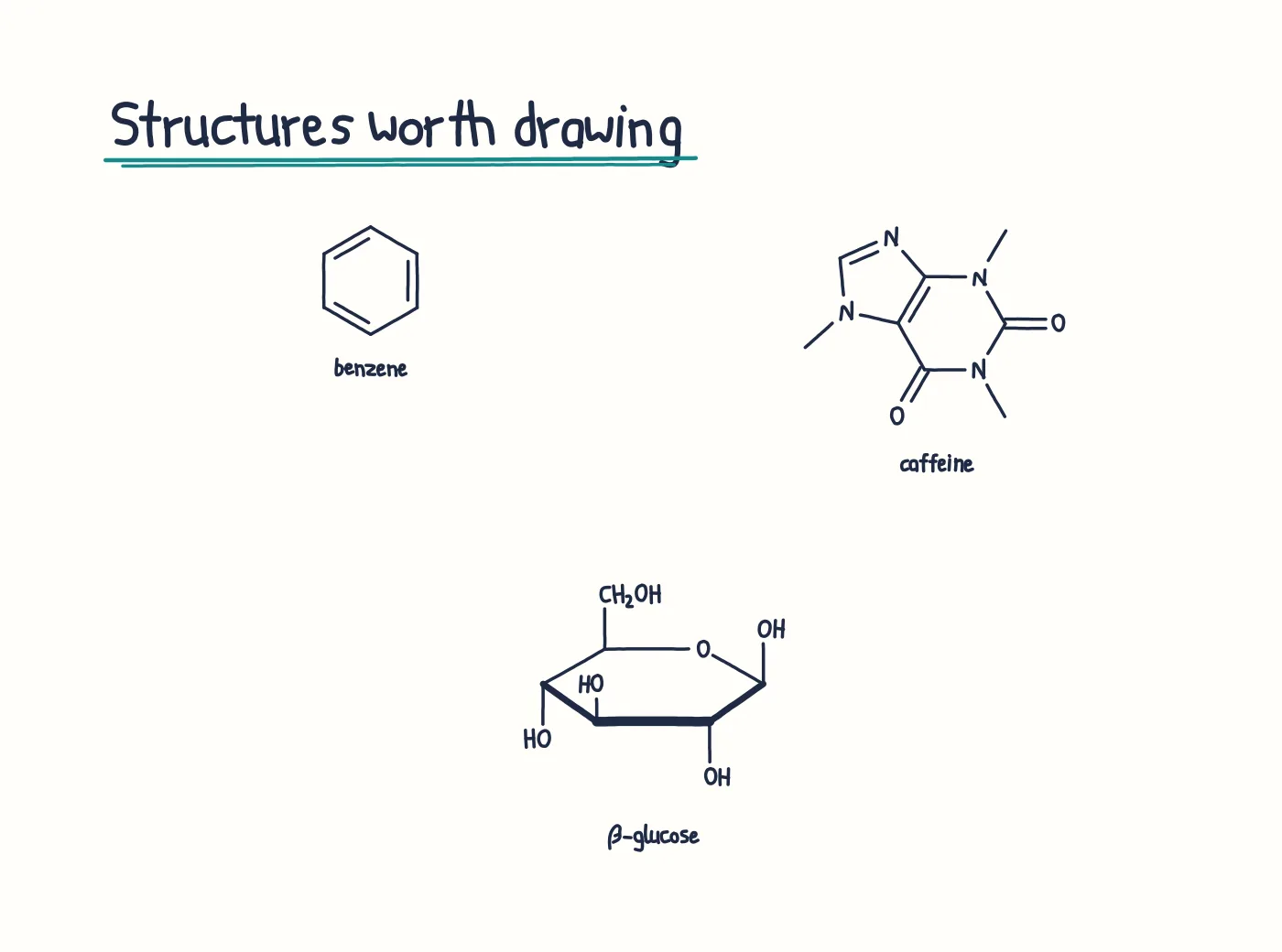
- Benzene: the basic aromatic ring.
- Glucose: as a chain and as a ring. The Haworth projection draws the ring flat, seen slightly from the side, with groups above or below the ring.
- Amino acids: the general structure with the amino group, the carboxyl group and the side chain R.
- Functional groups: alcohol, aldehyde, ketone, carboxylic acid, ester, amine, amide. Draw each one as a small fragment and learn to spot it inside larger molecules.
Reaction equations: balance first, then decorate
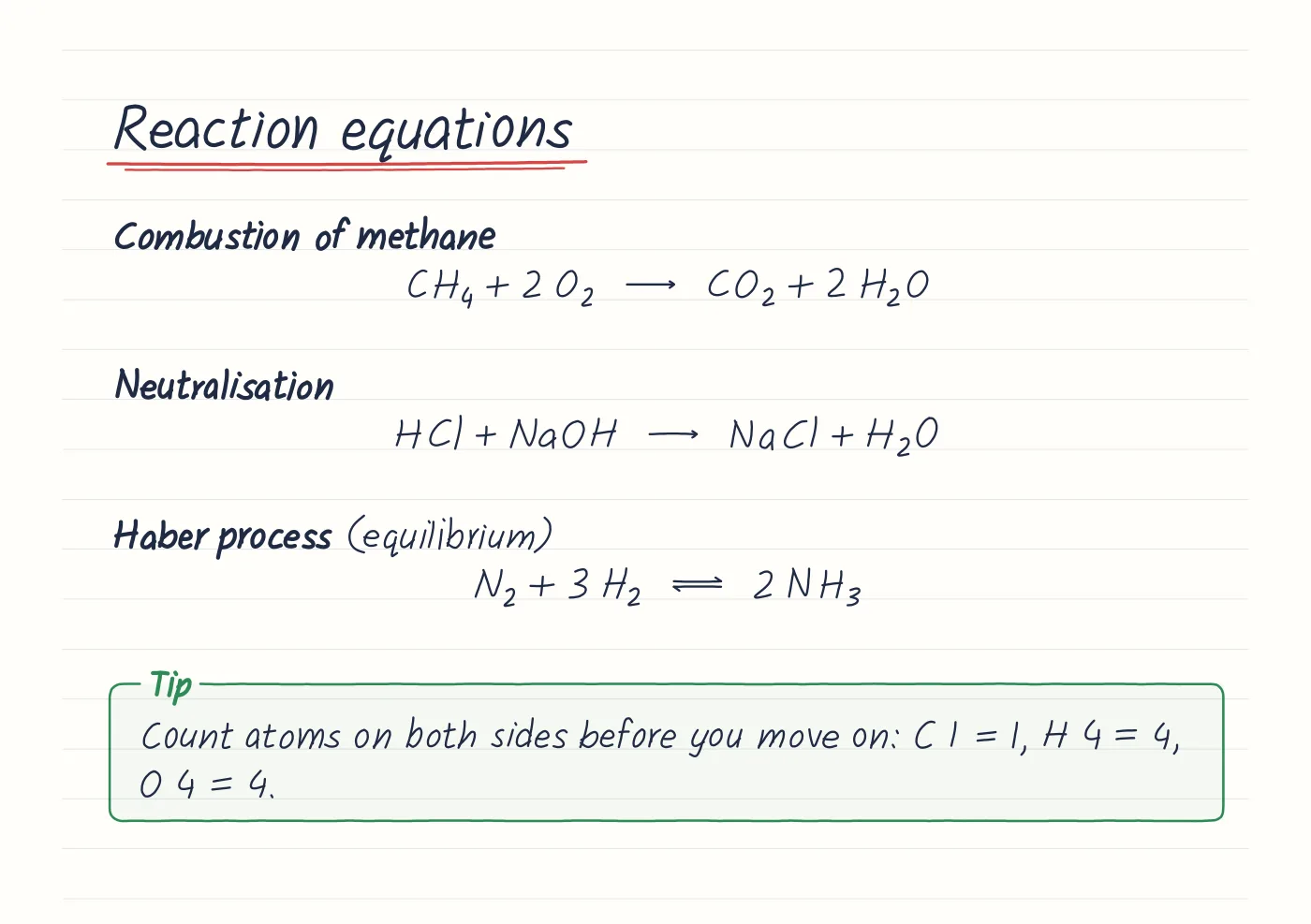
A reaction equation is a statement about atoms: none are created or destroyed. Before anything else, check that every element appears the same number of times on both sides.
A reliable way to balance:
- Write the correct formulas of all reactants and products. Never change a formula to make it balance; only change the coefficients in front.
- Balance the elements that appear in only one substance on each side first.
- Leave hydrogen and oxygen for last, since they often appear in several substances.
- Count every element once more at the end.
Arrows mean different things
Chemistry uses several arrows, and mixing them up changes the meaning:
- → a reaction that goes to completion (in the direction shown).
- ⇌ an equilibrium: the reaction runs both ways.
- ↔ (a double-headed arrow) resonance structures, not a reaction at all.
- Curly arrows in mechanisms show the movement of an electron pair, from where the electrons are to where they go.
Write conditions on the arrow: the catalyst above, temperature or pressure below. That is where a reader expects them.
States, charges and stoichiometry
- States go in brackets after the formula: (s), (l), (g), (aq). Use them when they matter, for example in precipitation reactions and thermochemistry.
- Charges go top right: Na⁺, SO₄²⁻. Write the number before the sign.
- Subscripts and coefficients are easy to blur in handwriting. Write subscripts clearly smaller and lower; leave a small gap after the coefficient.
Laying out a chemistry page
Chemistry pages get crowded fast. A few habits help:
- Grid paper makes structures and equations line up.
- One reaction per line, with space above and below for conditions.
- Name every structure underneath it the first time it appears.
- Use colour for what changes: highlight the functional group that reacts, or the bond that breaks, in one colour.
- A box for safety notes, especially in lab write-ups.
Practise from memory
The best exercise for chemistry is simple: look at a structure or an equation, cover it, and draw it again from memory. Then compare. For reactions, write the reactants and try to predict the products before you check. This kind of active recall is far more effective than reading a reaction list again, and it is the same technique described in the guide on flashcards and active recall.
Typed chemistry, written by hand
If you prepare notes on a computer, chemistry is usually where it gets awkward: structures need a drawing program and equations need special formatting. The pictures in this guide were written by the Inkside engine from plain text. Structures are given as SMILES strings (a standard text notation for molecules, such as CCO for ethanol) and equations in the common \ce{} notation, and the engine draws them in a handwriting style. You can try it in the Studio with your own reactions.