Maths and formulas by hand: layout, notation and graphs
How to write maths so you can follow it later: one step per line, aligned equals signs, clean notation, labelled graphs and a formula sheet that helps.
4 min read
In maths, how you write is part of how you think. A solution that wanders across the page, with steps squeezed between lines and equals signs pointing nowhere, is hard to check and easy to get wrong. The same solution written in clean steps can be read by a teacher in seconds, and by you a month later.
This guide is about writing maths by hand: on paper, on a tablet, in an exam.
One step per line
The most useful habit is also the easiest: write each step on a new line, and line up the equals signs under each other.
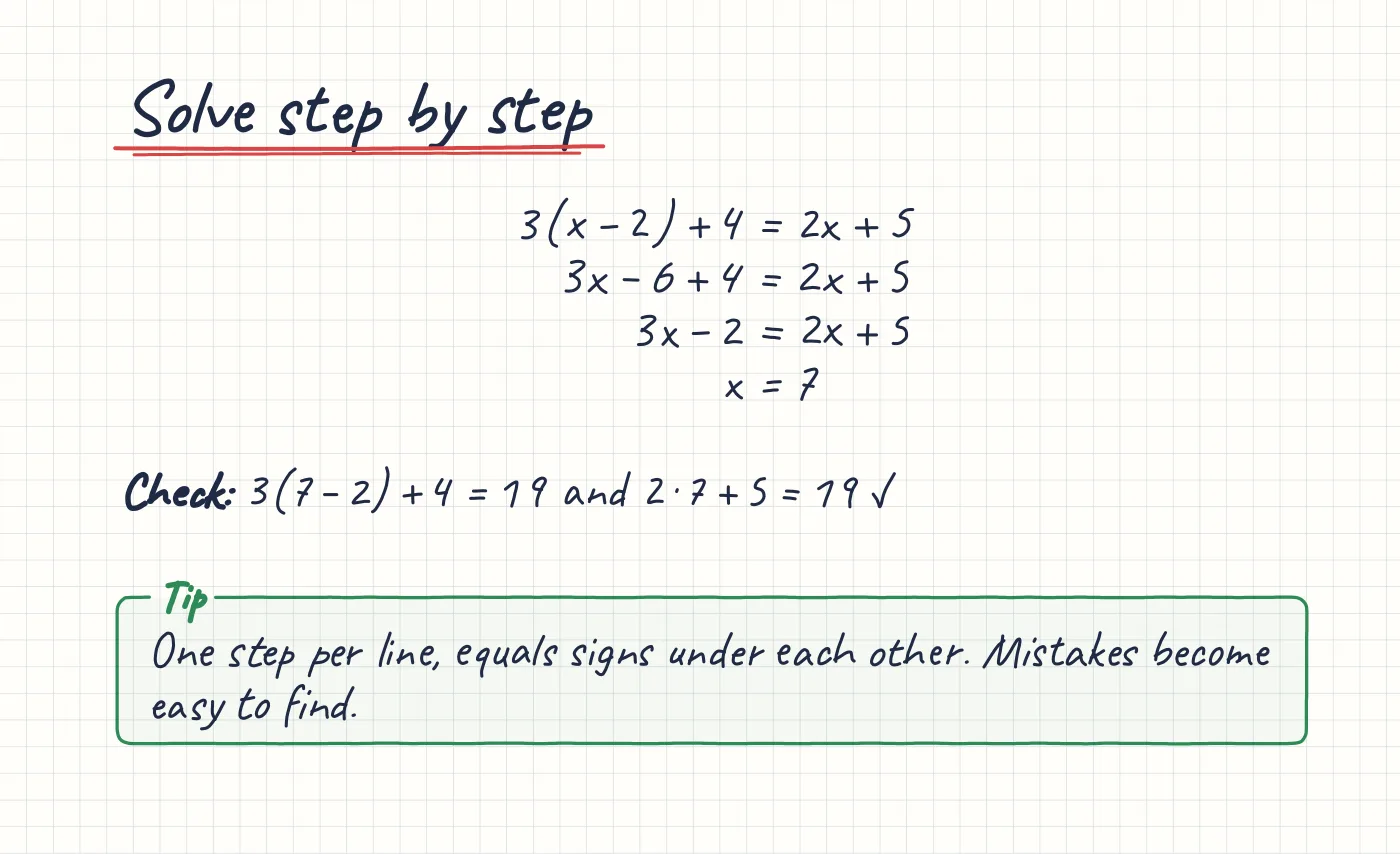
This does three things. You can see what changed from one line to the next. A mistake becomes visible because only one thing changes per line. And if you lose marks, the marker can see where, and often gives partial credit for the steps that were right.
A few related habits:
- Say what you are doing in a few words at the side, such as "expand", "÷ 3" or "substitute x = 2", especially in longer solutions.
- Never write a chain of equals signs between things that are not equal. "2 + 3 = 5 · 2 = 10" is wrong, even if you meant two steps.
- Check your answer by substituting it back. Write the check down: it takes a line and catches many errors.
Notation that survives handwriting
Some symbols get confused when written quickly. Decide on a form and use it every time:
- x and ×: write the multiplication sign as a dot (·), or leave it out, as in 3x.
- 1, 7 and l: a 7 with a cross bar, a 1 with a small flag, and a curly ℓ for a length if needed.
- z and 2: a z with a cross bar.
- Fractions: a horizontal bar, as long as the longer of numerator and denominator. Avoid slashes in anything longer than a/b.
- Minus signs: long and clear, especially in front of fractions.
- Brackets: tall enough to enclose what is inside. A fraction in small brackets is a common source of errors.
- Vectors: an arrow above or an underline. Pick one.
Formulas worth knowing by heart
A formula sheet is useful if you make it yourself, and much less useful if you download one. Writing it is the learning: you decide what you need, and you notice which formulas you do not really understand.
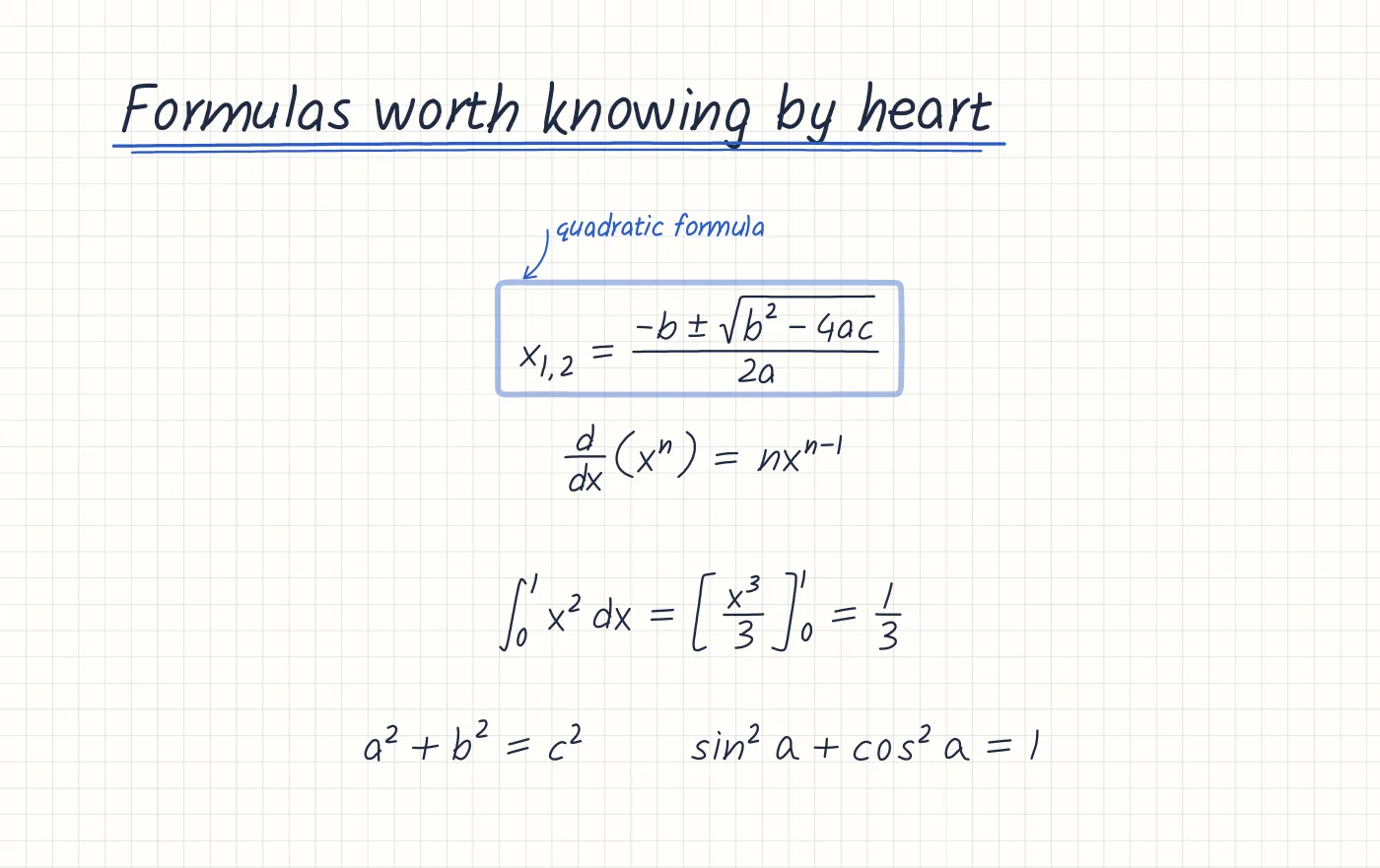
Guidelines for a good formula sheet:
- One page per topic, not per term.
- Every formula with its conditions: when does it apply? (The quadratic formula only for ax² + bx + c = 0 with a ≠ 0.)
- Every symbol explained once, unless it is completely standard.
- One small worked example next to formulas you tend to misuse.
- A box around the few you really need to know by heart.
Graphs that explain something
A sketch of a graph is often the fastest way to see what a problem is about. A good sketch does not need to be precise, but it needs to be labelled.
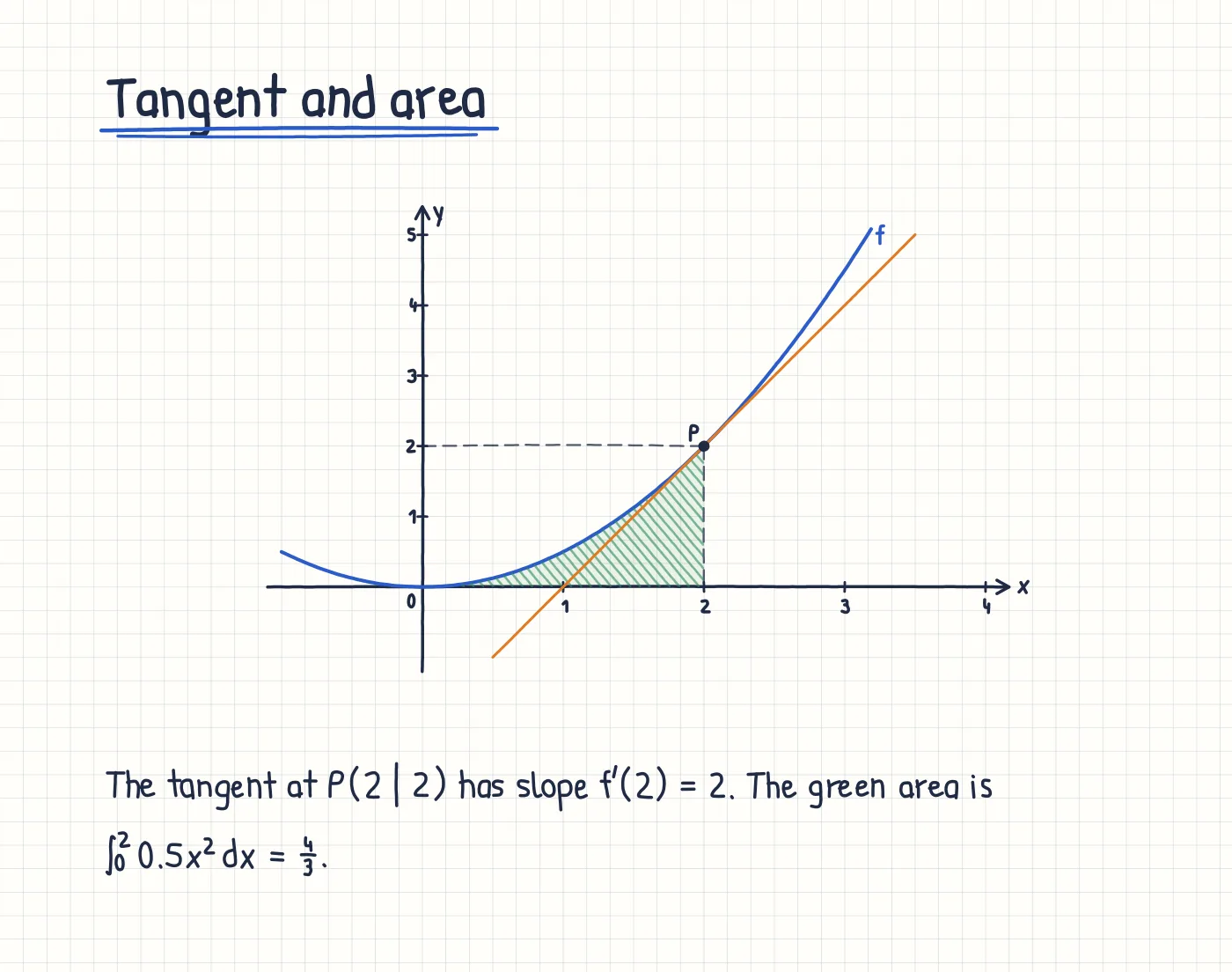
- Axes with labels and arrows: what is on each axis, and which direction is positive.
- A few marked values: intercepts, turning points, the point you care about.
- Different line styles for different functions, or a label next to each curve.
- Shading for areas, and dashed lines for asymptotes or guides to a point.
On grid paper, choose a scale that uses whole boxes per unit, so values can be read off directly.
Exam layout
In an exam, your page is read by someone who wants to give you marks. Make it easy:
- Number every part of the question clearly.
- Write the formula first, then substitute, then calculate. Each on its own line.
- Underline or box the final answer, with units.
- Cross out cleanly with a single line rather than scribbling: crossed-out work is ignored, scribbled work just looks messy.
- Leave space between parts, in case you want to come back.
On a tablet
Writing maths on a tablet has advantages: grid paper on every page, the lasso tool to move a step you forgot, and colours for different functions. Zoom in when writing fractions and exponents so they stay legible. If your app recognises maths handwriting, use it to check working, not to replace it.
When the maths is typed
Sometimes maths starts out typed: a worksheet from a teacher, notes you wrote in LaTeX, or formulas from a textbook. If you want them in the same style as your handwritten notes, the Inkside Studio writes LaTeX formulas and function graphs by hand. The pictures in this guide were made that way, from text such as \frac{-b \pm \sqrt{b^2 - 4ac}}{2a} and a short plot description. It is a quick way to make a tidy formula sheet, but writing the sheet yourself is still the better way to learn it.