Flashcards and active recall: how to learn so it stays
Why testing yourself beats rereading, how to write flashcards that work, and how a simple box system spaces your reviews.
4 min read
Rereading your notes feels like studying. The material looks familiar, every page seems to make sense, and after an hour you feel ready. The trouble is that recognising something on a page is not the same as being able to recall it on an empty exam sheet. Flashcards, used properly, train the second skill directly.
Active recall: retrieving is learning
Active recall means pulling information out of your memory instead of putting it in again. You look at a question, try to answer it without looking, and only then check.
Memory researchers call the effect behind this the testing effect or retrieval practice. A frequently cited study by Henry Roediger and Jeffrey Karpicke, published in 2006, had students either restudy a text or take practice tests on it. On a test shortly afterwards, restudying did about as well or better; on a test days later, the students who had practised retrieval remembered more. Many studies since then, in classrooms and labs, have found similar results. A large review of study techniques by John Dunlosky and colleagues in 2013 rated practice testing as one of the most useful techniques for students, and rated highlighting and rereading as much less useful.
The important point: retrieval is not just a way to check what you know. The act of retrieving makes the memory stronger.
What makes a good flashcard
A flashcard is a question on one side and an answer on the other. That sounds trivial, but most bad flashcards break one of a few rules.
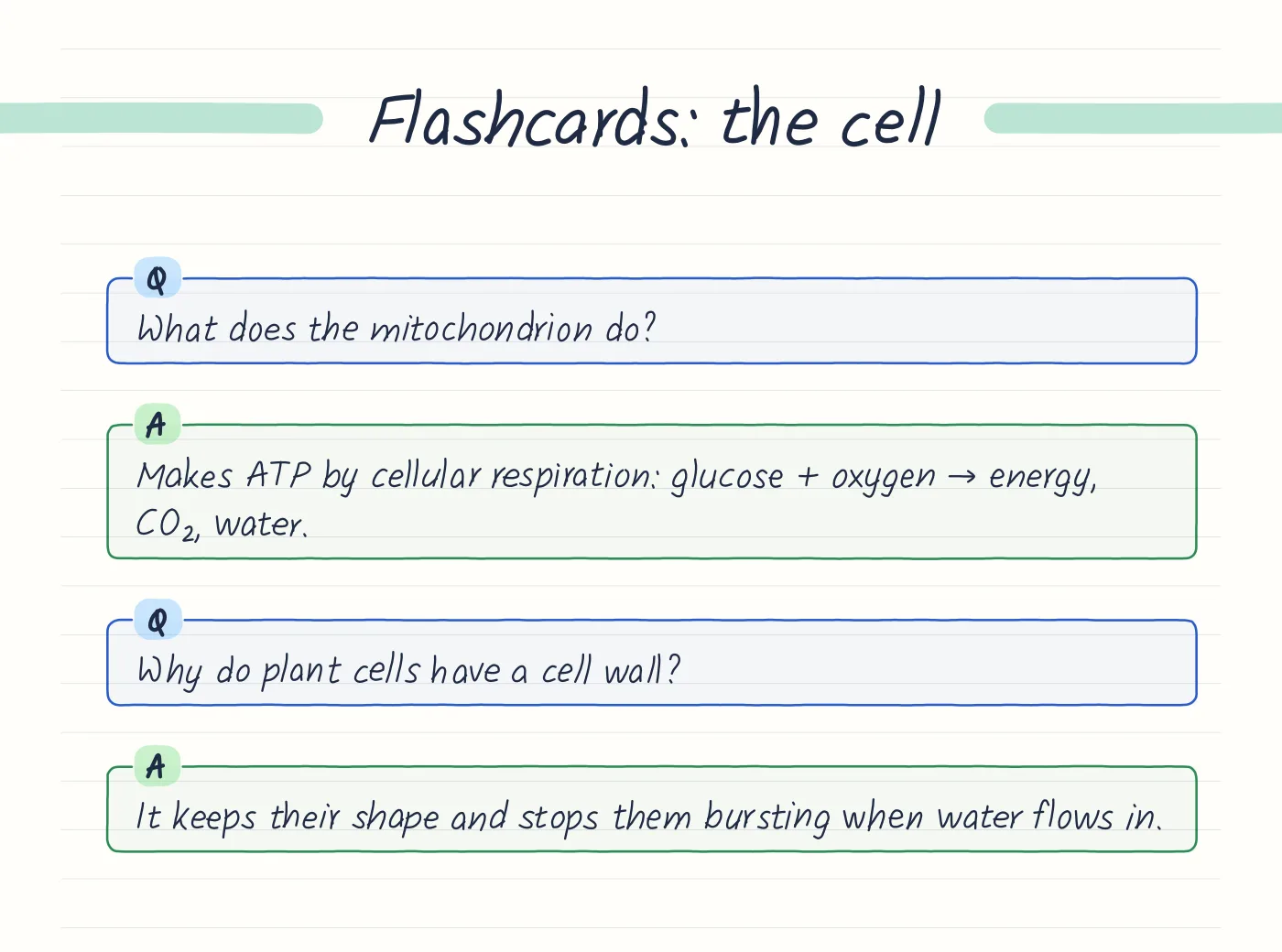
- One fact or idea per card. If the answer is a paragraph, split it into several cards.
- Ask a real question. "Mitochondrion" on the front is not a question. "What does the mitochondrion do?" is.
- Make the answer short. You should be able to say it in one breath.
- Ask in both directions for vocabulary and definitions: word to meaning, and meaning to word.
- Use your own words. Copying the textbook sentence onto a card is just rereading in a smaller format.
- Add a cue, not the answer. A small drawing or an example on the front can help, as long as it does not give the answer away.
Writing cards by hand
Writing your own cards is part of the learning. You have to decide what the question is and what counts as the answer, which forces you to understand the material. Ready-made decks skip that step.
Paper cards are cheap and work well: one stack per subject, rubber bands, a box. On a tablet, you can write cards as pages in a notebook, with the question at the top and the answer below a fold you cover with your hand. Some apps have built-in flashcard modes; the method matters more than the app.
Spacing: when to review
The second big finding of memory research is the spacing effect: reviews spread out over time lead to better long-term memory than the same amount of study crammed into one session. Hermann Ebbinghaus described forgetting curves in the 1880s, and the spacing effect has been confirmed many times since.
In practice, that means: review a new card soon, then again after a few days, then after a week, then after a few weeks. Each successful recall can wait longer before the next one.
The Leitner box
The simplest way to schedule spaced reviews by hand is the Leitner system, described by the German science journalist Sebastian Leitner in the 1970s. You need a box with several compartments, or a few envelopes.
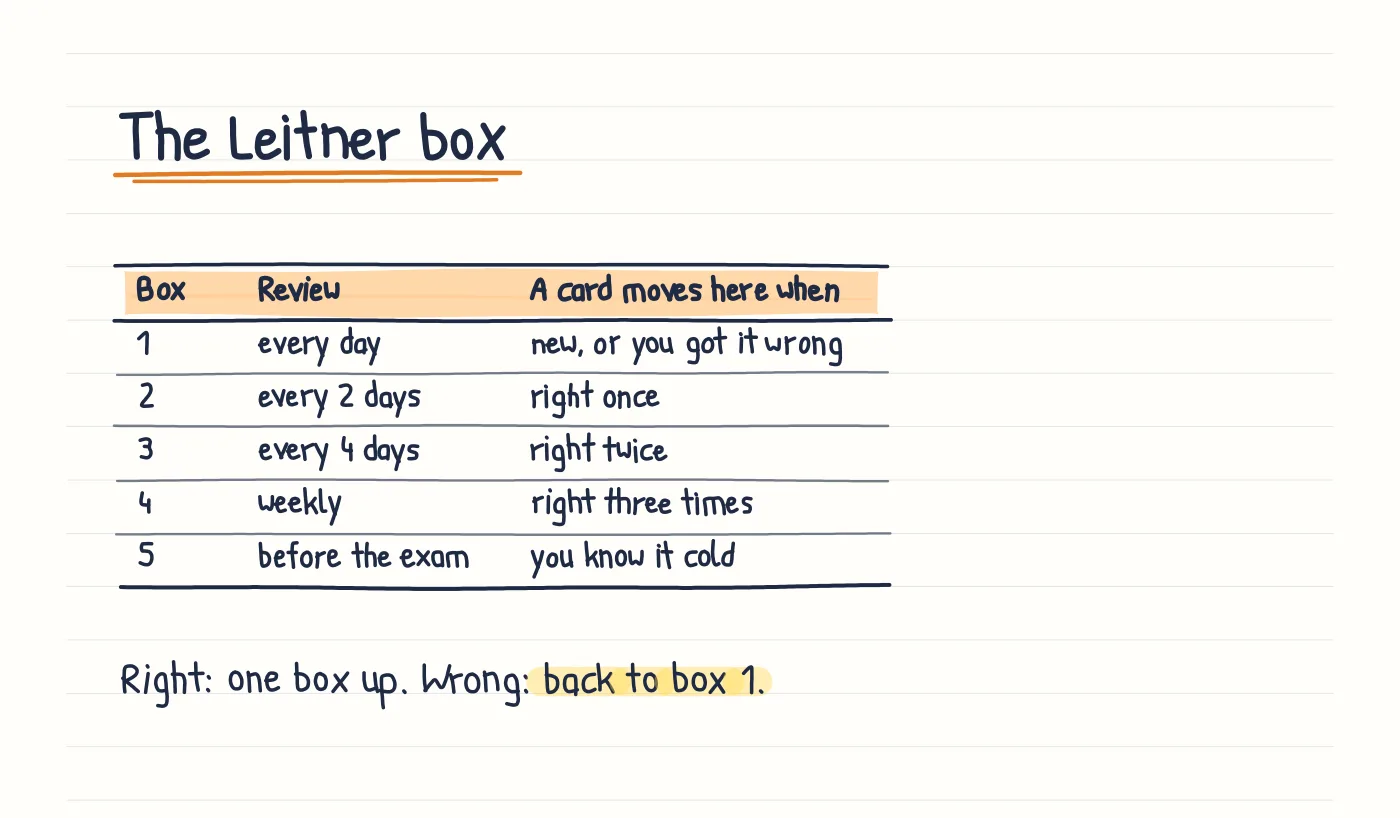
- All new cards go into box 1.
- Review box 1 every day, box 2 every few days, box 3 once a week, and so on.
- A card you answer correctly moves one box up.
- A card you get wrong goes back to box 1, however far it had come.
The effect is that you spend most of your time on the cards you do not know yet, and very little on the ones you know well. The intervals in the picture are an example; adjust them to the time you have before the exam.
Spaced repetition apps automate the same idea with an algorithm that schedules each card. They are useful for large decks, such as vocabulary. For a single school subject, a paper box is often enough.
Be honest with yourself
Flashcards only work if you actually try to answer before you look. A few rules:
- Say the answer out loud or write it down before flipping the card.
- "Almost right" is wrong. Put the card back.
- Shuffle the stack so you do not learn the order instead of the content.
- Retire cards you know well, or move them to a final "exam week" box.
Beyond flashcards
Active recall is not limited to cards. Other forms:
- Blank page recall: write down everything you remember about a topic, then compare with your notes.
- Cue column: the Cornell method's question column, described in the guide on study notes.
- Practice questions: old exams and textbook exercises, done without looking at the solutions.
- Explaining: teach the topic to someone else, or to an empty chair.
All of these share one thing: you produce the answer yourself. The guide on handwriting and memory looks at what research says about why that effort helps.
A simple weekly plan
- After each lesson: write three to five cards from your notes.
- Every day: ten minutes with box 1.
- Twice a week: the higher boxes.
- Before the exam: everything once more, the wrong ones twice.